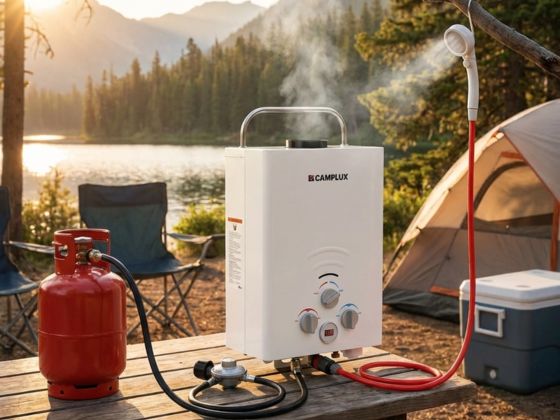
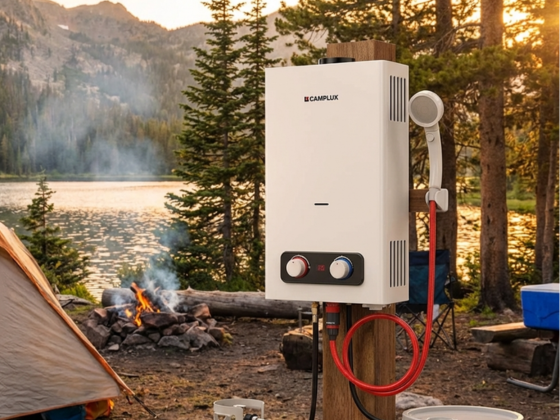
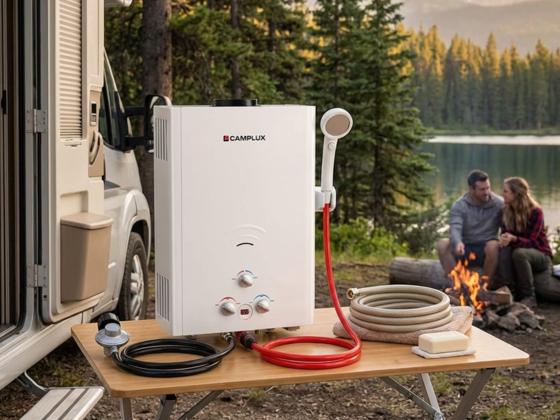
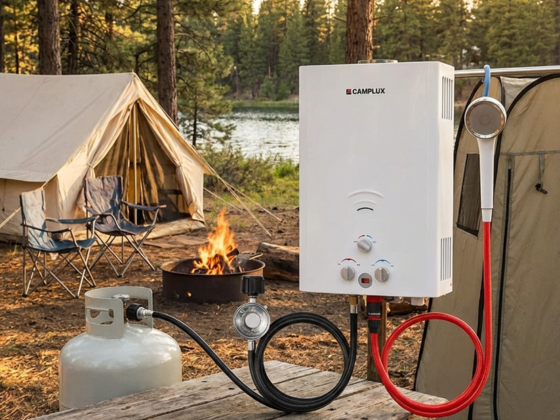
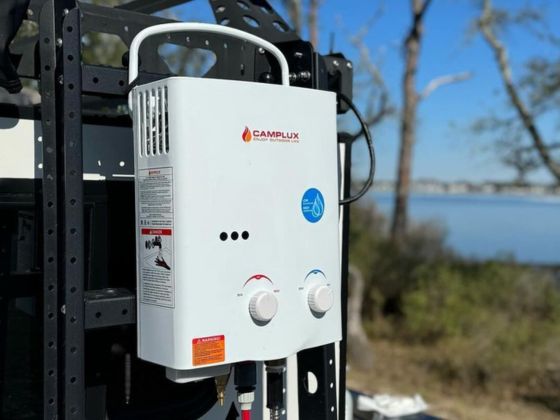
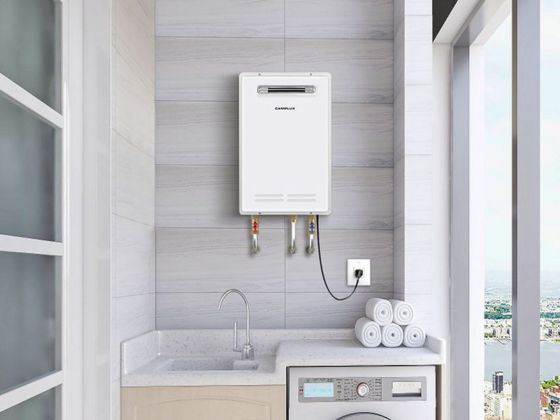
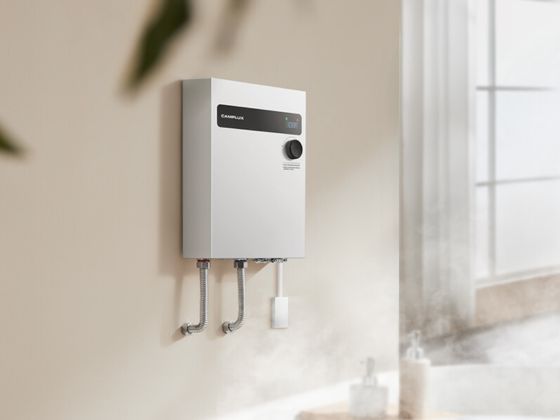

The top camping water heaters for Canadian Rockies adventures in 2026 are propane-powered portable units with CSA approval, a minimum 1.32 GPM flow rate, and cold-water start capability below 5°C. Models like the Camplux BW264G and the Camplux BW422G consistently appear in buyer shortlists for this region.
So what makes the Rockies different from regular camping? The groundwater temperature. Glacial meltwater feeding campsites near Banff, Jasper, and Kootenay runs significantly colder than most manufacturers test against. A heater that performs fine in Ontario cottage country may struggle to deliver a comfortable shower when your incoming water is hovering near 4°C.
And then there's the altitude. Many backcountry sites sit above 1,500 metres, where propane combustion efficiency drops slightly. Not dramatically, but enough that BTU ratings tested at sea level don't tell the full story. Worth keeping in mind as you compare specs.
If you're just getting started with your research, our Top Camping Water Heaters For Canadian Wilderness 2026 roundup covers the broader Canadian market. For Rockies-specific performance, read on.
What to Look for in a Rockies Camping Water Heater
BTU output and flow rate are the two numbers buyers focus on first. Fair enough. But for the Canadian Rockies specifically, the starting water temperature matters just as much. According to Camplux's 2026 propane heater guide, the BW422G delivers approximately 68,000 BTU and a 4.22 GPM flow rate — numbers that hold up even when incoming water is cold.
Low-pressure startup is another spec that separates field-capable units from ones that look good on paper. Many Rockies campsites rely on gravity-fed water sources or portable 12V pumps. A heater requiring 20+ PSI to ignite will frustrate you. The Camplux AY132P43 starts at just 3.0 PSI, which pairs well with a standard Camplux 12V diaphragm pump outputting 35 PSI max.
Weight and packability come third. You're not going to hike a 5.8 kg unit 12 km into the backcountry. But at a frontcountry drive-in site near Lake Louise, that weight is irrelevant. Knowing your setup determines whether you need sub-2 kg portability or whether you can trade weight for higher output.
Buyers often evaluate propane compatibility as a secondary concern, but it's worth checking early. Some units accept only 1 lb canisters; others work with 20 lb tanks via a standard regulator hose. For multi-day Rockies trips, a 20 lb tank is almost always more practical.
Key Benefits of a Portable Propane Water Heater in the Field
Hot water changes the camping experience in ways that are hard to overstate. Warm showers after a 20 km trail day. Clean dishwashing that doesn't require hauling water to a fire. Baby washes. Medical cleaning. The list is longer than most people anticipate before their first trip with a portable heater.
Propane units heat on demand — no tank to pre-warm, no waiting for an element to cycle. The Camplux FIRST F5 Pro delivers hot water in under 3 seconds from ignition, according to the manufacturer's spec sheet. When you're rinsing gear in 6°C air, that kind of immediacy isn't a luxury — it's just better.
Energy efficiency is a real advantage over electric alternatives at remote sites. There's no shore power requirement. No generator noise. Just a propane connection and running water. For off-grid Rockies camping specifically, that self-sufficiency is the point.
Durability in variable weather is where propane portables earn their reputation. Digital-display models like the BW264G let you dial in a target temperature and hold it steady, which removes the guesswork of "heat by feel" that budget units require. If you're shopping for a reliable mid-range option, the Camplux BW264G's View product details page covers the full spec breakdown and availability.
Side-by-Side Model Comparison: 2026
The table below compares the five most relevant Camplux models for Canadian Rockies use, plus two widely discussed competitors. Prices are in CAD at current Canadian retail. Competitor specs are sourced from publicly available manufacturer data — verify before purchasing.
| Model | Flow Rate | BTU Output | Min. Startup PSI | Digital Display | CSA Approved | Price (CAD) | Weight |
|---|---|---|---|---|---|---|---|
| Camplux AY132P43 | 1.32 GPM | ~34,000 BTU | 3.0 PSI | No | Yes | $299.99 | ~3.5 kg |
| Camplux BW158G | 1.58 GPM | ~41,000 BTU | Verify spec sheet | No | Yes | $269.99 | ~5.9 kg |
| Camplux BW264G | 2.64 GPM | ~55,000 BTU | Verify spec sheet | Yes | Yes | $369.99 | ~3.2 kg |
| Camplux BW422G | 4.22 GPM | ~68,000 BTU | Verify spec sheet | No | Yes | $539.99 | ~5.8 kg |
| Camplux Nano 3 Max | 3.0+ GPM | Verify spec sheet | Verify spec sheet | Yes (50–122°F) | Verify | $589.99 | Verify spec sheet |
| Joolca Hottap V2 | ~2.0 GPM | Verify with manufacturer | Requires 12V source | Yes | Verify | ~$500–$700 CAD | ~3.5 kg unit only |
| Eccotemp L5 | ~1.5 GPM | ~20,000 BTU | Verify with manufacturer | No | CSA-certified | ~$150–$200 CAD | ~2.5 kg |
If you prioritize digital temperature control at a mid-range price, the BW264G fits best. If raw flow rate and BTU output matter most for a family group, the BW422G is the stronger fit. The Eccotemp L5 suits solo campers who want simplicity and low cost. The Joolca Hottap V2 is designed for buyers who prioritize a fully integrated system and don't mind the added 12V dependency.
For a deeper look at where Camplux options sit across the full price spectrum, the Affordable Vs Premium Camping Water Heaters Canada 2026 breakdown is worth reading before you finalize a budget.
Who Is This For?
Solo backpackers doing hut-to-hut routes through the Rockies don't need a 5.8 kg unit. Something like the Camplux FIRST F5 at $199.99 CAD hits the right balance of weight and performance. It's a foldable, lightweight unit built for exactly this kind of mobility-first use case.
Families running a week-long frontcountry camp near Icefields Parkway have completely different needs. Two adults, two kids, gear washing, and dish duty adds up fast. A 4.22 GPM unit like the BW422G handles simultaneous demand without cycling off. That capacity matters when four people need showers before the evening gets cold.
RV travellers parking at serviced Rockies campgrounds often want something semi-permanent. The Camplux AY132BP43 — CSA-approved, compatible with a 12V pump, and usable with a standard 20 lb tank — works well mounted on an RV exterior wall for the season. The 3.0 PSI startup threshold means it pairs with low-pressure pump setups without issue.
One question that comes up a lot: can a single unit pull double duty for camping and home backup? Short answer — probably not. Most of the propane portables listed here are outdoor-only rated, and using a camping-rated propane heater indoors is a genuine safety risk, full stop. You'd need a different product category entirely for that.
How to Choose the Right Option
Start with group size. One person or two? A 1.32–1.58 GPM unit covers you fine. Three or more people expecting real showers? Step up to 2.64 GPM minimum. The BTU rating tells you how much the unit can raise incoming water temperature — higher BTU handles colder incoming water better, which is the defining challenge in the Rockies.
Next, think about your water source. Gravity-fed jugs and small 12V pumps produce low pressure. If that's your setup, the AY132P43's 3.0 PSI minimum startup is a practical advantage over units requiring 20+ PSI. Pairing it with the Camplux 12V pump at $48.99 CAD gives you a complete, affordable off-grid system.
Is a digital display worth the price premium? In the Rockies, genuinely yes. When incoming water temperature swings between 4°C and 15°C across the day, a display lets you hold a consistent output temperature rather than fiddling with the valve constantly. The BW264G's digital interface earns its keep here — it's not just a feature checkbox.
Best Portable Propane Water Heaters For Off Grid Canada 2026 covers the pump-pairing question in more detail if you're building a full off-grid water system rather than just picking a heater.
Real-World Performance in Cold Conditions
Here's what most reviews miss: flow rate specs are measured at a standard temperature differential, not at 4°C incoming. When glacial water hits a 34,000 BTU burner at maximum flow, the temperature rise may fall short of a comfortable shower. The fix is simple — reduce flow rate slightly to allow more heat transfer time. In practice, most users find that running a 1.32 GPM unit at 70–80% flow in cold conditions produces consistently warm output.
The BW422G's 68,000 BTU rating gives it enough thermal headroom to maintain decent flow even with very cold incoming water. For a group of four at a Banff-area site in September, that headroom matters. One risk to check is that higher BTU units consume propane faster — plan your tank supply accordingly for multi-day trips.
Wind is the other real-world factor. At exposed Rockies campsites, gusts can destabilize an open-flame propane burner. Most Camplux units include windshields as part of the housing design, but no portable heater is immune to sustained 40+ km/h winds. Setting up behind a vehicle or using a simple wind barrier makes a measurable difference in ignition reliability.
Across multiple Canadian camping seasons, digital-display models pull ahead of analog units whenever conditions get unpredictable — not because the hardware is radically different, but because the feedback loop lets you adapt faster. The Camplux Nano 3 Max at $589.99 CAD takes this further with real-time power and temperature display, a temperature range of 50–122°F, and overheat protection above 122°F — a combination that suits buyers who want maximum control in unpredictable conditions. View product details to see the full specification breakdown before deciding.
CSA Certification and Canadian Safety Standards
CSA approval matters more in Canada than many buyers realize. Gas appliances used in Canada should comply with CSA B149.1 (natural gas and propane installation code) and carry CSA Group listing where required. Uncertified units may void campsite permits and, more seriously, create genuine safety risks with propane under high-altitude or cold conditions.
The Camplux AY132, AY132G, AY132P43, and AY132BP43 all carry CSA approval for both US and Canadian markets — confirmed on the manufacturer's product pages. The BW158G and BW264G are also listed as CSA-approved. For the BW422G and Nano 3 Max, verify the current certification status directly on the product page or with Camplux customer support before purchasing, as listings can be updated.
Three safety mechanisms you want confirmed on any unit you bring into the Rockies: flame failure devices, anti-freeze protection, and overheat shutoff. Nights can drop below freezing even in July at higher elevations, and anti-freeze protection is what keeps residual water in the heat exchanger from cracking the unit while you sleep.
For a full breakdown of what each certification means and how to verify it for your specific model, the Camping Water Heater Certifications Canada: Full Guide covers the regulatory landscape in plain language.
Warranty, Returns, and Customer Support
Warranty terms vary by model — check the current listing on camplux.ca for the specific unit you're considering, as terms can change. Generally, Camplux portable propane heaters carry a limited warranty covering manufacturing defects; verify the exact term length and what's covered (parts, labour, or both) on the product page or by contacting support directly before purchasing.
Returns are processed through Camplux's Canadian operations. If a unit arrives damaged or fails within the return window, customer support can be reached through the website's contact page. A failed heater mid-trip isn't just inconvenient — it can derail the whole camp setup — so response time and resolution quality are worth checking in reviews before you buy.
One practical note: propane heaters used outdoors and exposed to Rockies weather will show wear faster than units stored indoors between trips. Inspect the burner screen, gas connections, and battery compartment at the start of each season. Most field failures trace back to corrosion or debris in the ignition system, not the heat exchanger — and both are preventable with basic maintenance.
Quick tip: register your product with Camplux after purchase. It simplifies warranty claims and gives you access to updated documentation if your model's spec sheet is revised. If you're comparing your options before committing, the Affordable Vs Premium Camping Water Heaters Canada 2026 article lays out where each price tier typically falls on warranty coverage as well.
Which One Should You Choose?
For solo or two-person Rockies campers who move sites frequently and need something lightweight and CSA-approved, the Camplux AY132P43 at $299.99 CAD is the strongest fit. The 3.0 PSI startup, CSA certification, and compatibility with a 12V pump give you a complete, compact system that works reliably at low water pressure. It won't win on flow rate, but for two people it doesn't need to. View product details for the full spec list and current Canadian pricing.
For families of three or four doing week-long frontcountry camps near Banff or Jasper, the Camplux BW422G at $539.99 CAD matches best. The 4.22 GPM flow rate and 68,000 BTU output handle simultaneous demand without throttling, and the gray finish holds up to field use. Yes, it's heavier than the entry-level models. But for a stationary camp setup, that trade-off is worth it.
For buyers who want digital temperature control, mid-range pricing, and a balance of portability and output, the Camplux BW264G at $369.99 CAD sits in the right place. The digital display is genuinely useful in the Rockies where incoming water temperature varies, and the ~55,000 BTU output handles most real-world cold-water scenarios at 2.64 GPM. Buyers who prioritize a fully integrated ecosystem with a single-vendor system and maximum display feedback may find the Nano 3 Max worth the premium step to $589.99 CAD.
Frequently Asked Questions
Can I use a propane camping water heater at high altitude in the Rockies?
Yes, but expect a slight reduction in combustion efficiency above 1,500 metres compared to sea-level BTU ratings. Propane burns less completely at higher altitudes due to lower atmospheric oxygen levels. In practice, reducing the flow rate slightly compensates for this. Always verify your specific model's altitude operating range in the manufacturer's documentation, as some units list a maximum elevation ceiling.
What size propane tank is best for a 5-day Rockies camping trip?
A 20 lb propane tank is the practical choice for trips of four or more days with daily shower use. A 1 lb canister lasts roughly 1–2 hours of continuous runtime on a mid-range burner, which isn't enough for multi-day family use. Some Camplux models include a regulator hose for 20 lb tanks in the box; others require a separately purchased adapter. Check the accessory list on your model's product page before heading out.
Do I need a water pump, or can I use a gravity-fed setup?
It depends entirely on the minimum startup PSI of your chosen heater. The Camplux AY132P43 starts at 3.0 PSI, which a gravity-fed jug elevated roughly 2 metres can achieve. Most other units in this category require 8–20 PSI, which typically needs a pump. If you're building a gravity setup, measure your actual water pressure before relying on it — a simple inline pressure gauge costs under $20 CAD and removes all the guesswork.
Are Camplux portable heaters rated for overnight sub-zero temperatures?
Most Camplux portable propane heaters include anti-freeze protection, which shuts the unit down before residual water in the heat exchanger can freeze and crack internal components. However, this protects the unit during operation, not during storage. If overnight temperatures drop below 0°C, drain the heater fully and store it in an insulated bag or inside your vehicle. A cracked heat exchanger from ice expansion is not typically covered under warranty.
Is the Camplux BW264G worth the price premium over the BW158G?
For cold-water conditions specifically, yes. The BW264G delivers approximately 14,000 BTU more than the BW158G (~55,000 vs ~41,000 BTU), plus a digital temperature display that removes the guesswork of adjusting output by hand. In summer camping in southern Canada, the BW158G performs adequately. In the Rockies, where incoming water sits near 4°C for much of the season, the extra BTU headroom and display feedback of the BW264G translate to consistently warm output rather than "warm enough" output.
What's the best way to extend the life of a portable propane water heater?
Drain it completely after every trip — this is the single most effective maintenance step. Flush the heat exchanger annually with a diluted descaling solution, especially if you're drawing from hard water sources. Store the unit indoors between seasons, and inspect the gas inlet, O-rings, and burner screen before each trip. A corroded O-ring on the gas connection is a common failure point that's inexpensive to replace proactively but expensive to discover mid-trip.