
It's a question that comes up constantly in Canadian camping forums: propane or electric? And honestly, most of the answers online are written for American campers with reliable shore power and mild winters. Canada is a different situation.
Ground water at 6°C. Campsites three hours from the nearest hardware store. Shoulder-season trips where the temperature swings 15 degrees between noon and midnight. If you're making this decision for Canadian conditions, the answer isn't the same as it is for a Florida RV park.
This guide breaks it down properly — no fluff, just the factors that actually matter when you're camping in Canada.
The Core Difference: How Each Type Works
Before comparing, it's worth being clear on what we're actually talking about.
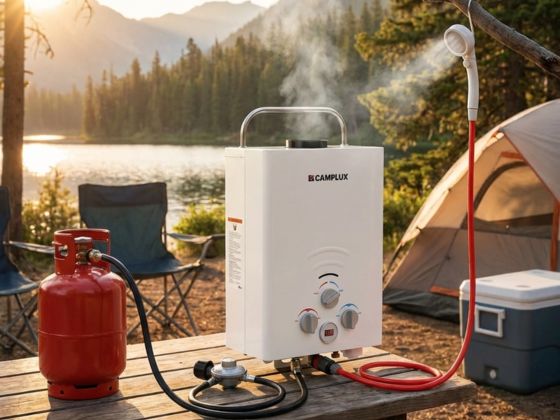
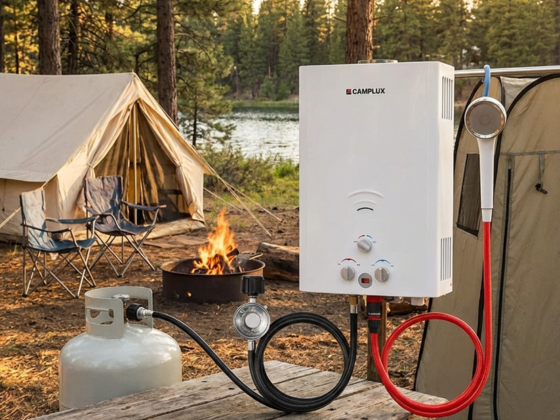
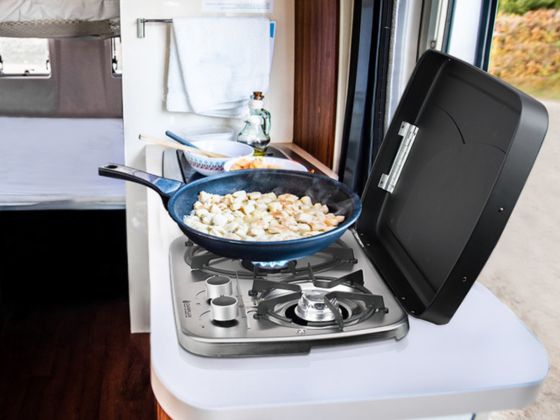
Propane portable water heaters use a gas burner to heat water on demand as it flows through a heat exchanger. No electricity required (beyond a small battery for ignition). Output is measured in BTU — typically 40,000 to 68,000 BTU for camping-grade units. They connect to a standard propane tank and a garden hose or 12V pump.
Electric portable water heaters — in the camping context — are typically small point-of-use tank units (1.3 to 6 gallons) that require a 110–120V power source. They heat a stored volume of water rather than producing it on demand. Output is measured in watts, typically 1,200–1,440W for compact units.
These are fundamentally different technologies, and that difference drives almost every practical consideration below.

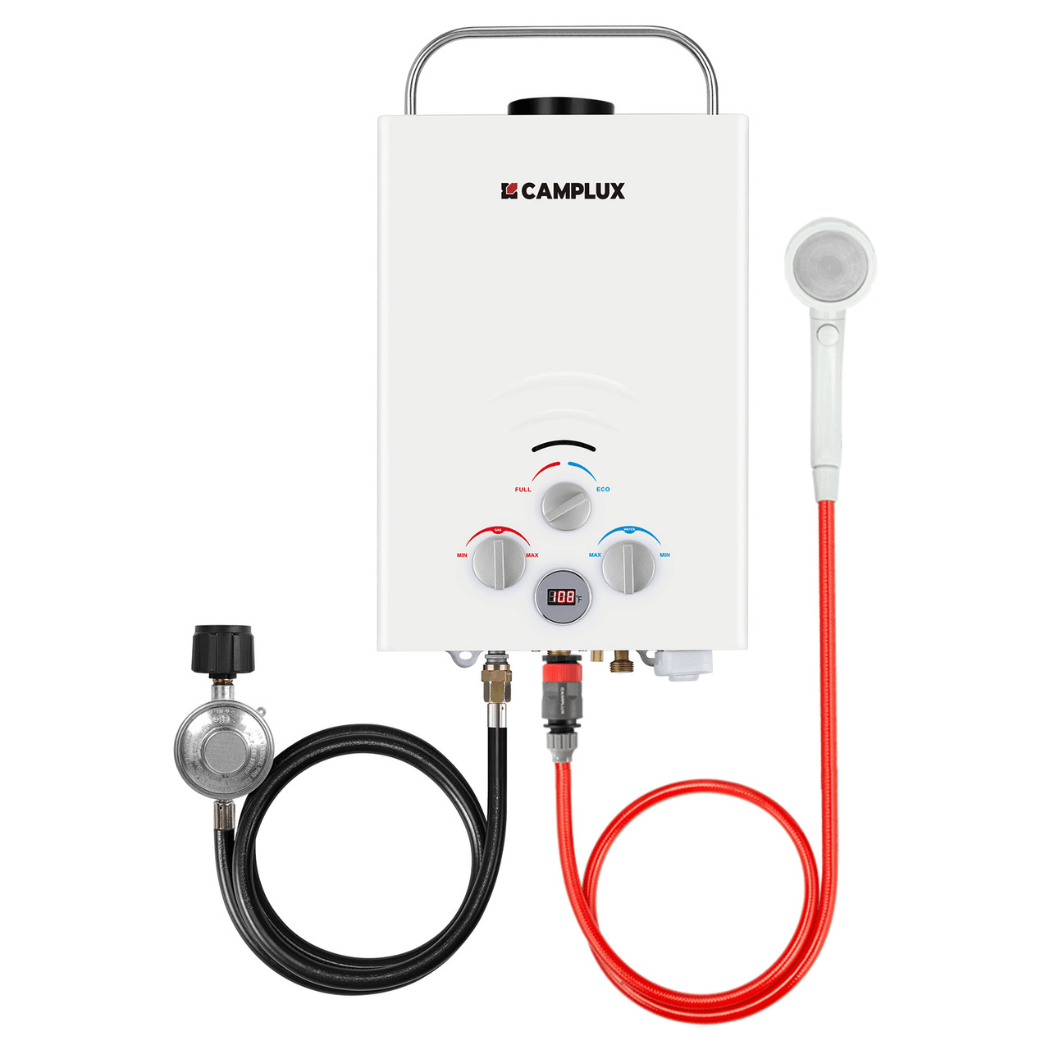
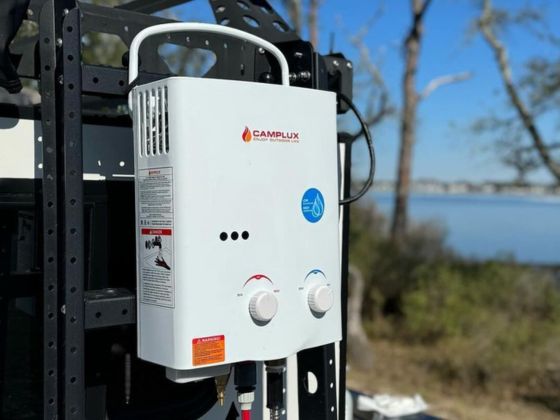
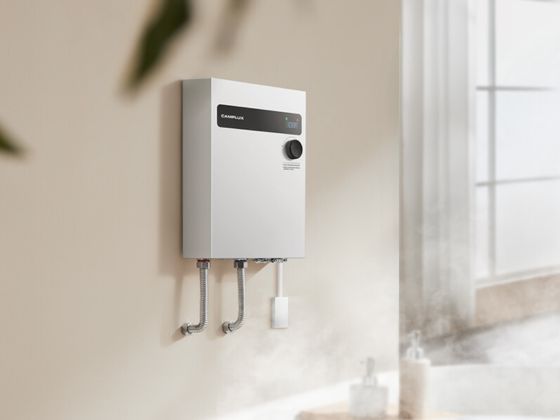
The Camplux BW158 — a compact 1.58 GPM propane unit ideal for solo campers and couples. No shore power required.
Round 1: Cold-Weather Performance
Propane wins clearly here.
Propane combustion is not meaningfully affected by ambient air temperature (though tank pressure drops in extreme cold — more on that below). A 50,000 BTU propane heater delivers roughly the same heating power at 5°C as it does at 25°C.
Electric tank heaters, on the other hand, lose efficiency in cold environments. The unit has to work harder to maintain water temperature in a cold tank, recovery time between uses increases, and in genuinely cold conditions (below 5°C ambient), some compact units struggle to reach comfortable shower temperatures with cold Canadian ground water as the inlet.
For shoulder-season camping in Ontario, Quebec, or anywhere in the Prairies, propane is the more reliable choice. If you're camping in BC's interior in October, this isn't a close call.
One caveat on propane: tank pressure does drop in cold temperatures. A propane tank that sat outside at -10°C overnight will have reduced pressure and may affect ignition. The fix is simple — bring the tank inside your vehicle or tent for 20–30 minutes before use. We cover this in more detail in our guide to setting up a portable water heater for Canadian camping.
Round 2: Fuel Availability Across Canada
Propane wins again — by a wide margin.
Propane is available at Canadian Tire, Home Hardware, Walmart, most gas stations, and virtually every hardware store across the country. In remote areas of northern Ontario, Manitoba, or BC, you can often find propane refills at small-town hardware stores or gas stations when nothing else is available.
Electric power at Canadian campsites is a different story. Electrical hookups (15A or 30A) are available at many provincial and national park campgrounds — but they're not universal, they require advance booking, and they come at a premium. Backcountry sites, Crown land camping, and most remote sites have no power at all.
If your camping style involves any degree of flexibility — spontaneous sites, Crown land, or backcountry — propane is the only practical choice. Electric only makes sense if you're exclusively booking powered sites at established campgrounds.
Round 3: Hot Water Output and Recovery
Propane wins on demand capacity. Electric wins on simplicity for small volumes.
A mid-range propane unit like the Camplux BW264 delivers 2.64 GPM (10L/min) of continuous hot water. Indefinitely. As long as you have propane and water pressure, it doesn't stop. That's enough for back-to-back showers for a family of four without anyone waiting.
A 2.5-gallon electric tank heater holds roughly 9.5 litres of hot water. That's one short shower. Then you wait 20–30 minutes for recovery. For a family, this becomes a scheduling exercise rather than a camping experience.
The electric advantage: for washing dishes, rinsing gear, or a single person's quick shower, a small tank heater is simple and quiet. No ignition, no gas connections, no minimum flow rate to trigger the burner. Plug it in, wait for it to heat, use it.

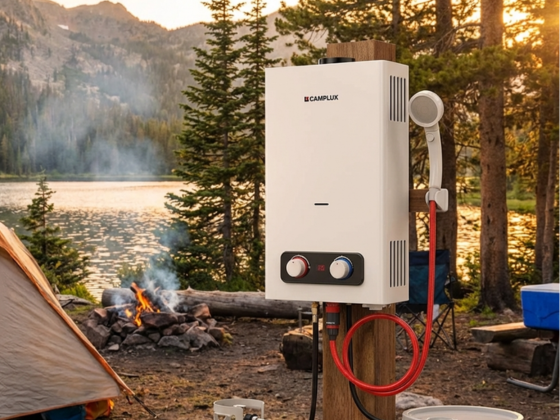
The Camplux BW264 delivers 2.64 GPM continuously — enough for back-to-back family showers with no recovery wait.
Round 4: Setup and Ease of Use
Electric is simpler. Propane is more versatile.
Electric tank heaters: plug into shore power, wait 15–20 minutes, use. That's it. No gas connections, no ignition troubleshooting, no minimum water pressure requirements.
Propane on-demand heaters require a few more steps: connect the propane tank, connect your water source (hose or pump), ensure adequate water pressure (0.5–0.7 GPM minimum to trigger ignition), and light the unit. Once running, they're straightforward — but the initial setup has more variables.
That said, propane setups become second nature after a trip or two. And the flexibility they offer — no power dependency, unlimited hot water, use anywhere — is worth the slightly higher setup complexity for most Canadian campers.
Round 5: Cost Comparison
Upfront cost is similar. Running cost favours propane for frequent campers.
Entry-level propane portable heaters start around CAD $80–120. Mid-range units with digital temperature control and higher flow rates run CAD $150–250. The full portable water heater range covers both ends of that spectrum.
Compact electric tank heaters (1.3–2.5 gallon) are similarly priced at CAD $80–150. The electric mini tank water heater lineup is worth comparing if you're considering this route for a powered campsite setup.
Running costs: a 20 lb propane tank costs roughly CAD $25–30 to fill and lasts 20–30 hours of heater use. For a family doing 10 camping trips per season, that's approximately CAD $75–100 in propane annually. Electric costs depend entirely on your campsite's power rate — typically included in the site fee at provincial parks.

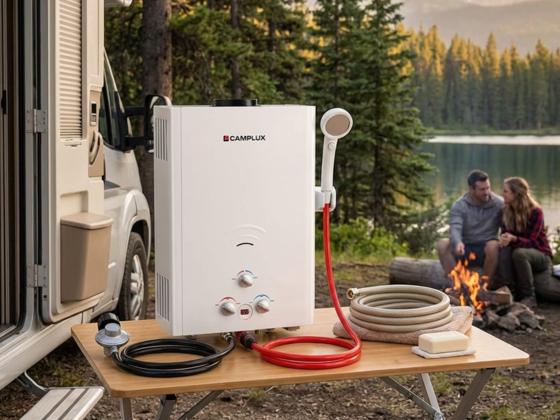
The Camplux FIRST F10 — a cost-effective propane option for campers who want reliable hot water without the premium price tag.
When Electric Actually Makes Sense
To be fair: there are scenarios where electric is the right call.
- Exclusively powered campsite bookings — If you always book electrical hookup sites at established campgrounds and never deviate, electric is simpler and perfectly adequate.
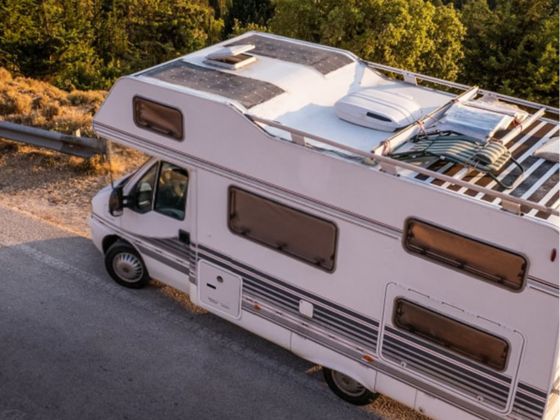
- RV with shore power — For RV setups with reliable 30A or 50A hookups, a point-of-use electric heater for the kitchen or bathroom makes sense alongside your main RV tankless water heater.
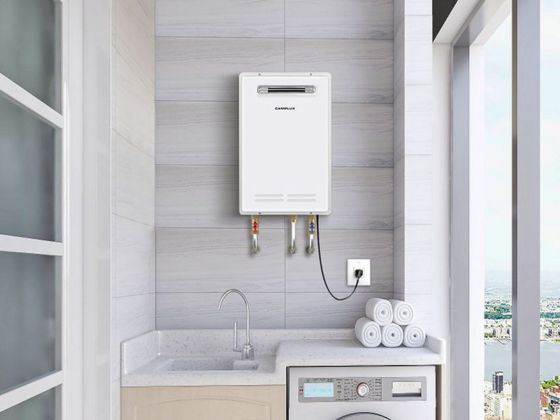
- Residential off-grid supplement — For a cabin with solar power, a small electric tank heater can work well as a supplementary unit. Though for primary off-grid hot water, a propane tankless water heater is typically more practical.
- Indoor use — Propane heaters must be used outdoors only. For indoor applications (tiny homes, cabins, seasonal properties), electric or a properly vented indoor gas tankless heater is the appropriate choice.
The Verdict for Canadian Campers
For the majority of Canadian camping scenarios — tent camping, car camping, Crown land, backcountry, shoulder-season trips — propane wins. The combination of fuel availability, cold-weather reliability, unlimited on-demand output, and independence from shore power makes it the practical choice for Canadian conditions.
Electric makes sense in a narrow set of circumstances: exclusively powered sites, indoor supplementary use, or RV setups with reliable shore power.
If you're still deciding on flow rate for your propane setup, our guide on choosing the right portable water heater for Canadian camping covers the 6L vs 10L vs 16L decision in detail. Or browse the full propane water heater collection directly to compare models side by side.
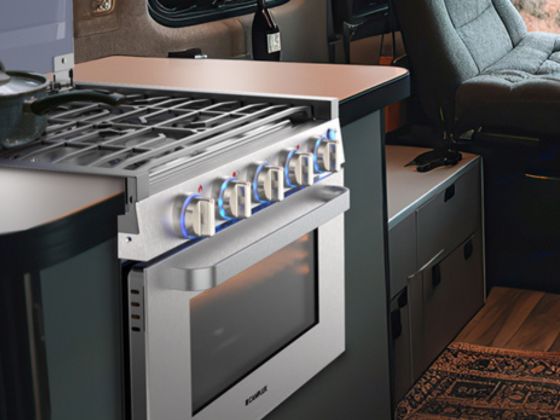
And if you're outfitting an RV rather than a tent camp, the RV appliances section has integrated solutions worth looking at before you decide.
One last thing: don't buy more heater than you need. A compact 6L propane unit handles solo and couple camping perfectly well. Save the 16L for when you actually need it.