
Camping gear sales in Canada hit a record high in 2024, and according to the Outdoor Recreation Council of BC, participation in backcountry and car camping grew by over 18% between 2022 and 2025. More Canadians are camping longer, further from services, and with higher expectations for comfort. Hot water is no longer a luxury people are willing to skip.
At the same time, the portable water heater market has expanded significantly. There are more options than ever — which sounds like a good thing until you're staring at a product listing trying to figure out what "1.58 GPM" actually means for your specific trip.
This guide cuts through the noise. By the end, you'll know exactly which portable water heater fits your situation — and why.
Step 1: Define Your Trip Type First
Before you look at a single spec, answer this: what does your typical camping trip actually look like?
This matters more than any technical detail. A heater that's perfect for a solo weekend at a provincial park is the wrong tool for a family of five doing two weeks on Crown land in northern Ontario. Get the use case right first, then match the hardware to it.
Here are the four most common Canadian camping scenarios and what each one actually needs:
Scenario A: Solo or Couple, Weekend Trips, Car Camping
You're packing light, you're not showering for an audience, and storage space in the car matters. You need something compact, easy to set up, and reliable. You do not need 16L/min of output.
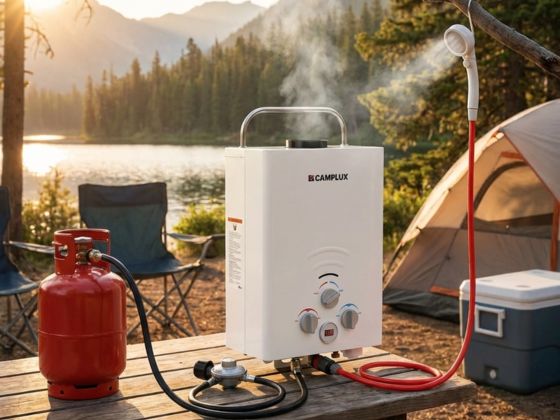
What to look for: 1.5–2.0 GPM (6–8L/min), lightweight, simple ignition, 1 lb propane canister compatible.
Scenario B: Family of 3–5, Multi-Day Trips
Back-to-back showers. Dishes. Rinsing muddy kids and wet dogs. You need real output and you need it consistently. Recovery time between uses is not acceptable.
What to look for: 2.5–3.0 GPM (10–12L/min), 20 lb tank compatible, digital temperature control, wind-resistant burner.
Scenario C: Group Camping (6+ People) or Extended Off-Grid
You're running a camp kitchen, multiple showers, and possibly washing gear. This is where undersized heaters fail. You need high output and you need it to run for hours without issue.
What to look for: 4.0+ GPM (16–20L/min), high BTU (55,000+), robust build quality, 20 lb tank minimum.
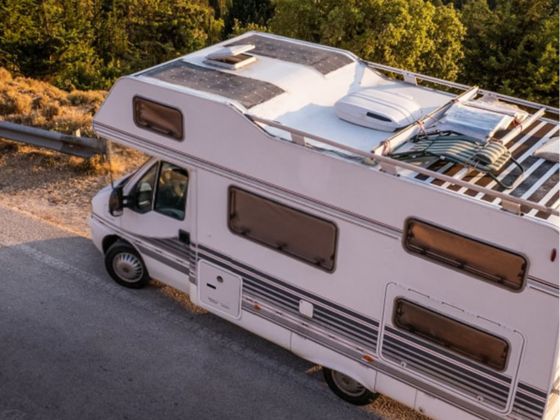
Scenario D: Van Life or Truck Camper
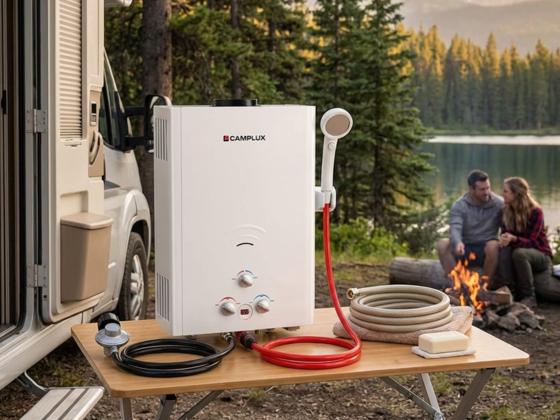
You're not just camping — you're living in a vehicle. Integration with your water system matters. A standalone portable heater works short-term, but a plumbed-in camper water heater or RV tankless unit is the right long-term solution.
Step 2: Understand Flow Rate (This Is the Most Important Spec)
Flow rate — measured in GPM (gallons per minute) or LPM (litres per minute) — tells you how much hot water the heater produces continuously. It's the single most important number on the spec sheet, and it's the one most people misread.
Here's the critical thing most listings don't explain: flow rate and output temperature are inversely related. The faster water moves through the heat exchanger, the less time it has to absorb heat, and the cooler the output. In Canada, where ground water can be 6–8°C, this relationship matters a lot.
Practical example: a heater rated at 2.64 GPM with a 25°C temperature rise will output approximately 31–33°C water when your inlet is 6°C. That's a lukewarm shower. Dial the flow back to 1.5 GPM and the same heater outputs 38–40°C — genuinely comfortable. This is why matching flow rate to group size matters: you want to run the heater at a flow rate that delivers comfortable temperature, not maximum volume.

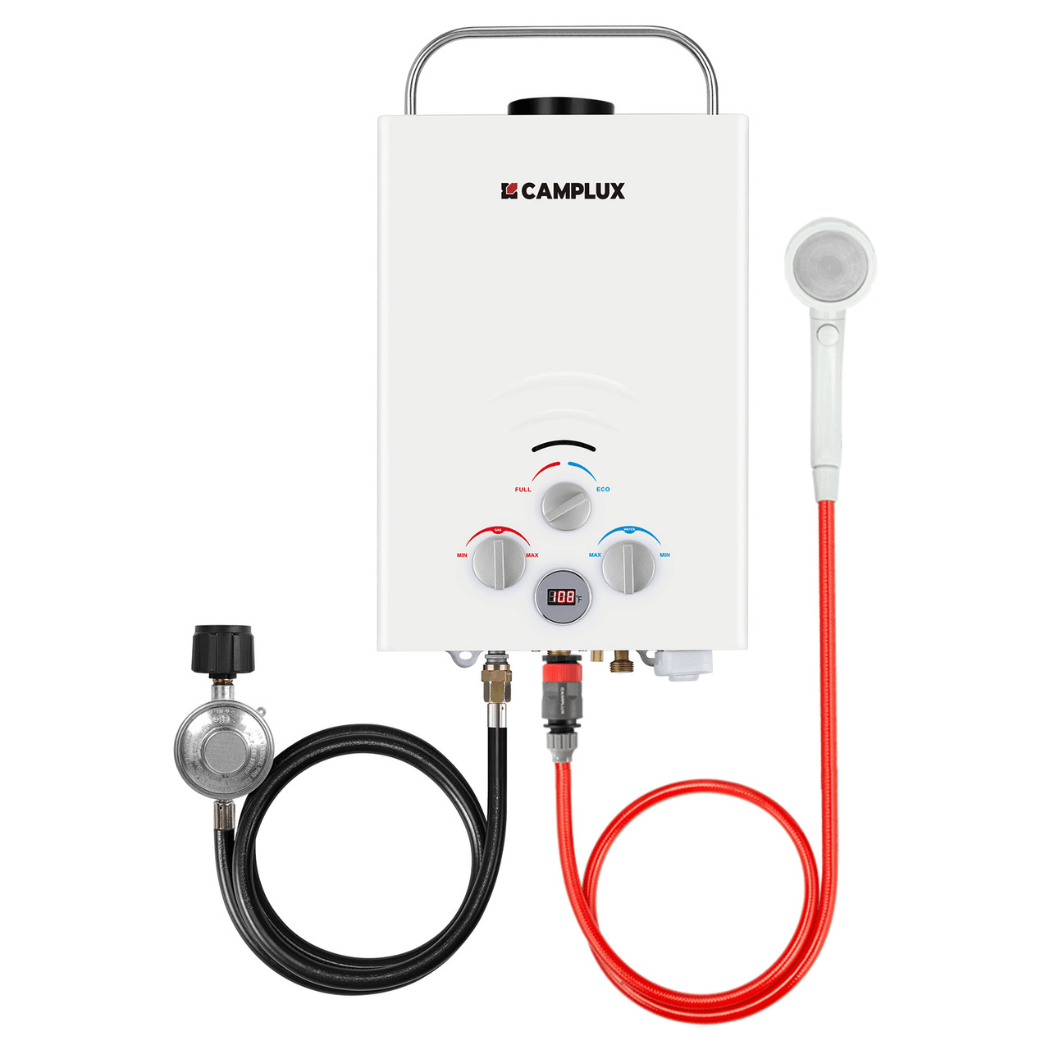
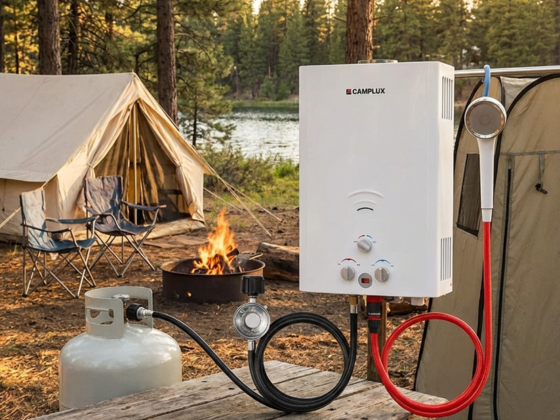
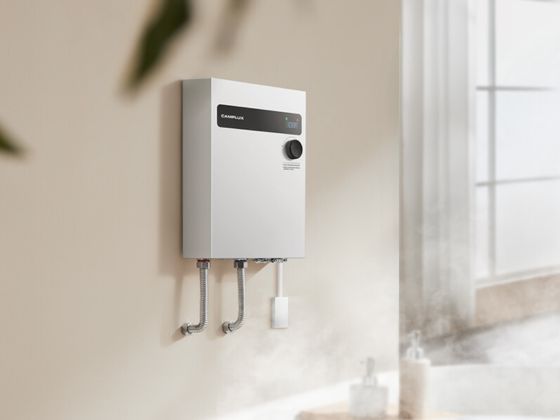
The Camplux FIRST F10 Pro — digital temperature control lets you dial in the exact output you want, regardless of inlet water temperature.
Step 3: Match the Model to the Scenario
Here's the direct answer most guides avoid giving. Based on the scenarios above:
Best for Solo / Couple Camping: Camplux FIRST F10 Pro
The FIRST F10 Pro hits the sweet spot for solo and couple camping. Compact enough to pack without sacrificing cargo space, digital temperature display so you're not guessing at output, and reliable electronic ignition that works in cold Canadian mornings. It's the unit we'd recommend to anyone doing weekend trips at Ontario or BC provincial parks.
What makes it stand out: the upgraded burner design handles wind better than most units in its class, and the battery ignition is consistent down to low single-digit temperatures — which matters in May and September in most of Canada.
Best for Families (3–5 People): Camplux BW264
The BW264 at 2.64 GPM (10L/min) is the family workhorse. Enough output for back-to-back showers, digital display for temperature precision, and a build quality that holds up to regular use across a full Canadian camping season. Connect it to a 20 lb tank and you're covered for a week without refilling.
One thing worth knowing: the BW264 requires a minimum 0.6 GPM flow to trigger ignition. If you're using a gravity-feed setup, pair it with a 12V pump — the accessories section has compatible options.
Best for Groups / Off-Grid: Camplux BW422
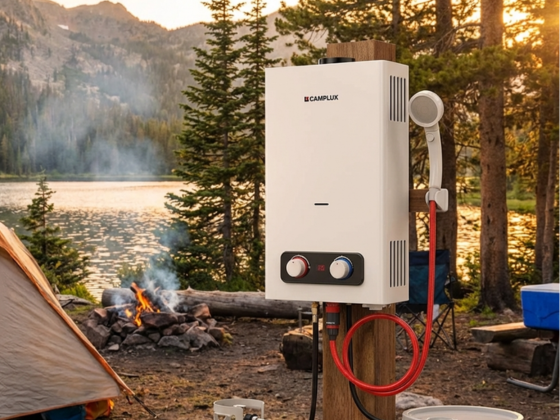
For groups of six or more, or anyone running a camp kitchen alongside showers, the BW422 at 4.22 GPM (16L/min) is the right tool. It's not the most compact unit in the lineup, but it delivers the output that larger groups actually need. Run it at 3 GPM for comfortable shower temperature with cold Canadian inlet water, and you have enough capacity to keep everyone moving without waiting.

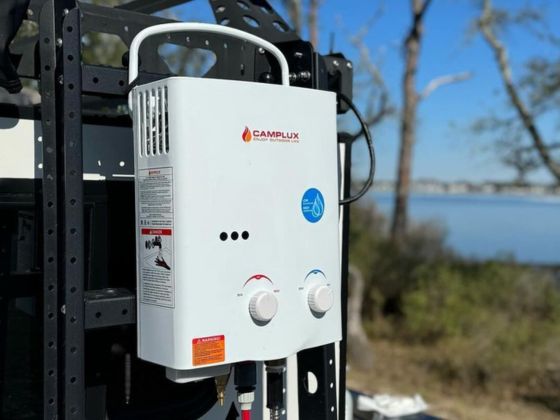
The Camplux BW422 — 4.22 GPM output built for group camps and extended off-grid use where hot water demand is high.
Best for Ultralight / Backpack-Adjacent Camping: Camplux Nano 3 Pro
The Nano 3 Pro is a different category entirely. Built-in 4,000mAh battery (no external power needed), compact enough to fit in a daypack, and designed for situations where weight and packability matter as much as output. It's not a replacement for a full-output unit — but for solo backcountry trips or minimalist setups, it's the most portable hot water solution in the lineup.

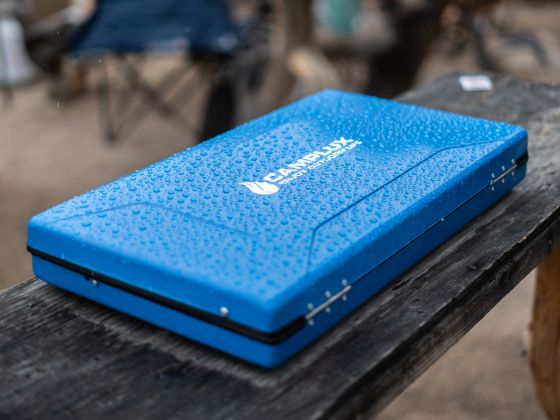
The Camplux Nano 3 Pro — built-in 4,000mAh battery, no external power required. The most packable hot water solution in the lineup.
Step 4: Don't Overlook These Practical Details
Water Pressure Source
Most portable heaters need 0.5–0.7 GPM minimum flow to trigger ignition. Your options: garden hose from a campsite tap (easiest), a 12V diaphragm pump from a water container (most flexible), or a gravity-feed bag (works but may be marginal on pressure). For anything beyond a campsite tap, a 12V pump is the reliable solution — check the water heater accessories range for compatible pumps.
Propane Tank Size
1 lb canisters: convenient, widely available, but expensive per BTU and only last 1–1.5 hours. 20 lb tanks: much better value, 20–30 hours of use, but require a regulator and hose adapter. For any trip longer than a weekend, a 20 lb tank is the practical choice.
CSA Certification
Already covered in our portable water heater overview, but worth repeating: for propane appliances used in Canada, CSA certification is the standard to look for. It confirms the unit has been tested to Canadian safety requirements for gas appliances.
2026 Market Context: Why Now Is a Good Time to Buy
A few things worth knowing about the current market. Global supply chain disruptions that affected outdoor gear pricing in 2022–2023 have largely normalized. Portable water heater prices in Canada have stabilized after two years of volatility, and inventory levels are healthy heading into the 2026 camping season.
More relevant for Canadian buyers: the federal government's ongoing push toward electrification has increased interest in propane as a transitional fuel for off-grid applications — which has driven investment in more efficient propane appliance technology. The newer units in the Camplux lineup reflect this: better heat exchangers, more precise temperature control, and improved cold-weather ignition compared to units from three to four years ago.
If you've been putting off the purchase, 2026 is a reasonable time to buy. The technology is mature, the prices are fair, and the 2026 camping season in Canada is shaping up to be another strong one based on provincial park booking data released earlier this year.
Quick Decision Guide
- Solo or couple, weekend trips → Camplux FIRST F10 Pro or browse 6L models
- Family of 3–5, multi-day → Camplux BW264 or browse 10L models
- Large group or off-grid cabin → Camplux BW422 or browse 16L models
- Ultralight / backcountry → Camplux Nano 3 Pro
- Van life or full-time RV → RV appliances or camper water heaters
- Off-grid cabin, permanent install → residential tankless water heaters
Still not sure? The full portable water heater collection is organized by flow rate, which is the fastest way to narrow it down. Start there, filter by output, and you'll have your answer in under five minutes.
The right heater doesn't make camping more complicated. It makes it noticeably better — and once you've had a hot shower after a cold day on the trail, you won't go back.