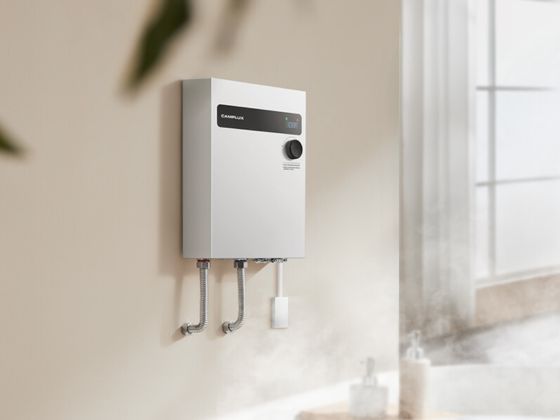

Electric mini tank water heaters give Canadian apartment and tiny home dwellers a compact, point-of-use hot water solution that installs under a sink in under an hour, draws from a standard 120V outlet, and stores 1.3 to 8 gallons of ready-to-use hot water. They work best where long pipe runs cause cold-water lag or where a second hot water zone is needed without major plumbing changes.
So why would someone in a well-serviced apartment building even need one? Fair question. The answer depends on your building's plumbing layout. Older Canadian apartment towers, particularly those built before the 1980s, often have long horizontal pipe runs to bathrooms and kitchens. You can wait 45 to 90 seconds for hot water at the tap. A point-of-use mini tank eliminates that wait entirely.
Tiny home builders face a different problem: 120V shore power is often all they have, and a full-size tank water heater is simply out of the question. If you're fitting out a small space on a budget, the Camplux Electric Mini Tank Point of Use Water Heater 120V - 1.3 Gallon or its larger siblings are worth a serious look. And if you're weighing this against a portable propane option, the Best Portable Propane Water Heaters For Camping Canada 2026 guide covers that side of the decision well.
What Is an Electric Mini Tank Water Heater?
A mini tank water heater is a small storage-style electric heater designed to sit under a sink or inside a cabinet close to the point of use. Unlike a tankless heater, it keeps a pre-heated reservoir ready at all times. The trade-off: you get instant hot water delivery, but you do pay a small standby energy cost to maintain that stored temperature.
Most residential mini tanks run on 120V standard outlets and draw between 1.44 kW and 1.5 kW of power. That matters for Canadians in apartments where 240V circuits are rarely accessible without an electrician and a permit. The 120V plug-in design is the single biggest practical advantage for renters and tiny home dwellers who can't modify their electrical panels.
Storage capacity ranges from 1.3 gallons up to 8 gallons in this product class. At the low end, a 1.3-gallon unit handles handwashing and light kitchen use. At the high end, an 8-gallon tank can support a shower in a well-insulated tiny home if the flow rate is kept low. Figuring out where you fall on that spectrum is really your starting point.
One more thing buyers often ask: is this the same as a tankless heater? No. A tankless unit heats water on demand with no stored reserve, which requires much higher wattage (typically 18 kW to 24 kW for a whole-home unit like the Camplux Whole House Electric Tankless Water Heater 24kW). A mini tank stores hot water and replenishes it slowly, making it viable on a 15-amp 120V circuit.
Key Benefits for Canadian Apartments and Tiny Homes
The most immediate benefit is eliminating cold-water lag. In buildings where the main water heater is 20 metres of pipe away from your kitchen, a point-of-use mini tank delivers hot water in under 3 seconds. That's not a marketing number — it's a function of the water already sitting at temperature, right where you need it.
Energy savings are real but context-dependent. A point-of-use mini tank cuts out the water waste from running the tap while you wait — and Canadian households lose an average of 4 to 9 litres a day to cold-water purge alone, depending on pipe length. Over a full year, that shows up in both water bills and heating costs. The insulated tanks in Camplux models reduce standby heat loss, which keeps operating costs reasonable even in colder Canadian seasons.
For tiny home builders, the 120V plug-in format is a genuine structural advantage. No dedicated circuit, no panel upgrade, no permit in most Canadian provinces for a plug-in appliance. Just an outlet and a drain line. The Camplux Electric Mini Tank Water Heater 120V - 8 Gallon at 489.99 CAD offers the largest storage in this plug-in class and is sized for real daily use rather than just handwashing.
Renters benefit from portability. Because these units are plug-in and connect to existing plumbing with standard fittings, they can move with you when your lease ends. That's a factor that full-size tank heaters and even some tankless units simply can't match.
Who Is This For?
Apartment renters in older Canadian buildings are the most common buyers. If your building went up before 1990, there's a decent chance you're dealing with shared hot water systems and long pipe runs. A mini tank under the kitchen sink solves the lag problem without requiring any landlord permission beyond mounting a small bracket.
Tiny home and cabin owners are the second major group. A 4-gallon or 6-gallon unit can handle morning routines for one or two people if showers are kept short and efficient. This is also a practical option for seasonal cottages where propane isn't available or preferred.
Buyers who are not a good fit: anyone expecting a mini tank to replace a whole-home water heater for a family of four. That's simply not the use case. For that scenario, a dedicated 18-gallon electric tank like the Camplux 18 Gallon Electric Water Heater or a high-output tankless unit makes more sense. Mini tanks are supplemental or point-of-use solutions, not primary whole-home systems.
Home office and workshop setups are an underrated use case. A 1.3-gallon or 2.5-gallon unit under a utility sink means you're not running to the main bathroom every time you need warm water for cleaning up. Low cost, quick install, practical daily payoff.
How to Choose the Right Option
Start with your daily hot water demand. A single person doing dishes and handwashing can get by with 2.5 to 4 gallons. Two people sharing a kitchen and a single bathroom need at least 6 gallons. Add the capacity you need for recovery: mini tanks on 120V circuits recover slowly (roughly 1 hour per gallon, depending on incoming water temperature), so a larger tank gives you more buffer between uses.
Check your outlet situation before you order. All Camplux mini tanks in this category run on 120V and draw approximately 1.44 kW to 1.5 kW. A standard 15-amp circuit handles that comfortably. But if your under-sink cabinet has no outlet, you'll need an electrician to add one — budget roughly $150 to $300 for that work in most Canadian cities.
Warranty terms are worth scrutinizing, not just skimming. Verify the current warranty specifics directly with Camplux customer support or on the product page before purchasing, as terms can vary by model and are updated periodically. At minimum, look for separate tank and parts coverage — a tank warranty shorter than 5 years is worth questioning for a unit you plan to keep long-term.
For returns and customer support: Camplux ships to Canadian addresses with a returns process you can access through camplux.ca. If anything arrives damaged or doesn't perform as described, reaching out to customer support directly is the fastest path to resolution. Check the maintenance guidance for your specific model before installation — a few simple steps during setup can extend the unit's service life considerably.
The Camplux Mini Tank Lineup: Sizes and Trade-offs
Camplux offers five distinct mini tank sizes in the 120V plug-in format, ranging from 1.3 gallons at 229.99 CAD to 8 gallons at 489.99 CAD. Each uses a glass-lined tank to resist scale buildup, which matters more in Canadian cities with harder municipal water (Calgary and the GTA, in particular, have notably high hardness levels). The built-in insulation foam across all models reduces standby heat loss, which is meaningful when the unit runs 24 hours a day in a kitchen cabinet.
The 1.3-gallon ME10 is purely a handwashing and light kitchen supplement. It heats quickly because the volume is small, and at 229.99 CAD it's the lowest entry point. The 2.5-gallon ME25 at 249.99 CAD adds a bit more buffer for kitchen use without a dramatic price jump. These two are the right picks for renters who just want to stop waiting for hot water at the tap.
The 4-gallon ME40 at 289.99 CAD and the 6-gallon ME60 at 329.99 CAD are the mid-range options for tiny homes and off-grid cabins. They can support low-flow shower heads if you're disciplined about usage. The 6-gallon tends to be the sweet spot for one-person tiny home use — enough capacity to feel like real hot water access, small enough to fit in a compact under-sink cabinet.
The 8-gallon ME80B at 489.99 CAD is the top of the plug-in range. It's physically larger and heavier when full — water weighs roughly 3.8 kg per gallon, so a full tank comes in around 30 kg. Make sure your cabinet or mounting wall can handle that load before ordering. This model is the practical choice for two people in a tiny home or for anyone who wants real shower capacity from a 120V circuit.
Side-by-Side Comparison: Camplux Mini Tank Models
The table below compares all five Camplux mini tank models on the criteria that matter most for Canadian apartment and tiny home buyers. Prices are in CAD as listed on camplux.ca.
| Model | Capacity | Price (CAD) | Power Draw | Best Use Case | Outlet Type | Tank Lining |
|---|---|---|---|---|---|---|
| ME10 | 1.3 Gallon | $229.99 | 1.5 kW | Handwashing, light kitchen | 120V standard | Glass-lined |
| ME25 | 2.5 Gallon | $249.99 | 1.5 kW | Kitchen + bathroom handwashing | 120V standard | Glass-lined |
| ME40 | 4.0 Gallon | $289.99 | 1.44 kW | Tiny home, studio apartment | 120V standard | Glass-lined |
| ME60 | 6.0 Gallon | $329.99 | 1.44 kW | Tiny home (1 person), off-grid cabin | 120V standard | Glass-lined |
| ME80B | 8.0 Gallon | $489.99 | Verify current spec | Tiny home (2 people), primary hot water | 120V standard | Glass-lined |
If you're weighing the 4-gallon against the 6-gallon, the $40 price gap is fairly easy to justify for the extra buffer capacity. The jump from 6 to 8 gallons is larger in both price and physical size, so that decision depends on whether two people are genuinely sharing the unit for showers. For anyone at that stage, View product details on the ME80B to confirm current dimensions and mounting requirements before purchasing.
Canadian Electrical and Safety Compliance: What to Check
This is actually a common point of confusion for Canadian buyers comparing appliances listed on North American retail sites. CSA Group certification (the Canadian equivalent of UL listing in the US) is the baseline you want for any plug-in electric water heater used in Canada. CSA-certified products meet the electrical safety requirements recognized by provincial electrical inspection bodies across the country. Always check for the CSA mark on the product or its documentation before purchasing any electric appliance for permanent installation.
For energy efficiency, NRCan's Minimum Energy Performance Standards (MEPS) apply to storage water heaters sold in Canada. The relevant efficiency metric for tank-style electric heaters is the Uniform Energy Factor (UEF). Higher UEF scores mean less energy lost to standby heating. For small point-of-use mini tanks, the UEF values tend to be lower than for full-size tanks due to the higher surface-area-to-volume ratio, but the reduced pipe losses often offset that in real-world operation. Verify the current UEF rating for any specific model directly from the manufacturer's spec sheet.
Provincial code variations matter less for plug-in 120V appliances than for gas or hardwired electric units, but Ontario's Ontario Building Code (OBC) and BC's Building Code do have provisions about water heater installation in dwelling units. In practice, a plug-in mini tank installed under a sink by a homeowner or renter typically falls outside the scope of permits required for hardwired installations. Still, if you're in a strata building in BC or a co-op in Ontario, a quick word with building management before you install is worth the two minutes it takes.
The Canada Consumer Product Safety Act (CCPSA) requires that all consumer appliances sold in Canada meet federal safety standards. Buying from camplux.ca means you're purchasing through a Canadian retailer with direct access to customer support, warranty service, and a returns process under Canadian consumer protection rules. That's a meaningful distinction from buying grey-market units through cross-border marketplaces.
Installation Reality: What No One Tells You
Most product pages describe installation as simple, and for the most part it is. But there are a few friction points worth knowing upfront. First, the pressure relief valve (T&P valve) on any storage water heater needs a drain line routed to a safe discharge point. Under a kitchen sink, that usually means running a small copper or CPVC tube down to the drain cabinet. It's a 20-minute job with basic tools, but it's not optional — skipping it is a code violation in every Canadian province.
Second, the cold water inlet and hot water outlet connections need to be plumbed into your existing supply lines. If your under-sink cabinet already has shutoff valves (most Canadian kitchens do), this is straightforward with push-fit fittings. If not, you'll need a plumber for that part. Budget $100 to $200 for a half-hour plumbing call if you're not comfortable with pipe fittings.
Quick tip: check your outlet amperage before ordering. A 15-amp circuit is standard and handles the 1.44 to 1.5 kW draw fine. But some older apartment buildings have 10-amp circuits in kitchen areas, which can trip breakers under sustained load. Your building's electrical panel labelling (or your super) can confirm this in about two minutes.
Weight is the other practical concern. An 8-gallon unit filled with water weighs roughly 30 kg. If you're mounting it under a cabinet rather than floor-standing it, the cabinet base and mounting bracket need to handle that. Most modern kitchen base cabinets can, but cabinets in older buildings sometimes have particleboard floors that compress over time under sustained weight. A simple plywood reinforcement panel solves this for under $20 in materials.
Which One Should You Choose?
For a renter in a Canadian apartment who primarily wants to eliminate cold-water lag at the kitchen tap, the Camplux Electric Mini Tank Point of Use Water Heater 120V - 2.5 Gallon at 249.99 CAD hits the practical sweet spot. Small enough to fit virtually any under-sink cabinet, runs on a standard outlet, and delivers instant hot water for kitchen and bathroom handwashing without any meaningful standby cost penalty. If you're the type who moves between apartments every year or two, the compact size is a genuine perk. View product details to confirm current stock and shipping timelines for your province.
For a solo tiny home or off-grid cabin owner who needs a genuine primary hot water source, the 6-gallon ME60 at 329.99 CAD is the strongest match. It provides enough stored capacity for low-flow morning routines, fits a 120V shore power connection, and the glass-lined tank handles the hard water common across much of Ontario, Alberta, and BC better than bare-metal alternatives. The price-to-capacity ratio at this tier is the most balanced in the Camplux lineup. If you're also planning a seasonal propane backup, the Best Portable Propane Water Heaters For Camping Canada 2026 guide pairs well with this decision.
For two-person tiny homes or anyone who genuinely wants to cover full shower needs from a single 120V plug-in unit, the 8-gallon ME80B at 489.99 CAD is the right call. It's the largest capacity available in the plug-in class, and while the price jump from the 6-gallon is significant, the alternative is either a 240V hardwired installation (which requires permits and an electrician in most provinces) or a propane tankless unit. For buyers who want electric-only and maximum hot water availability, there's no better-positioned option in this format. Check the Best Times To Buy Tankless Water Heaters Canada 2026 if timing your purchase around seasonal pricing is part of your plan.
Frequently Asked Questions
Can I use a mini tank water heater as my only hot water source in a tiny home?
Yes, but with realistic expectations about capacity. A 6-gallon or 8-gallon unit can serve one or two people in a tiny home if low-flow fixtures are used and showers are kept under 5 minutes. Recovery time on a 120V circuit is slower than a 240V tank, so back-to-back long showers will exhaust the stored supply. Planning your usage schedule around the recovery window makes it workable for most tiny home lifestyles.
Does a mini tank water heater work with low water pressure?
Mini tank heaters are gravity-fed or pressure-fed depending on installation. They connect to your home's cold water supply line, so they work at whatever pressure your building provides. There's no pump required. In most Canadian apartments, municipal water pressure runs between 40 and 80 PSI, well within the operating range of these units. If your building has pressure issues, that's a separate plumbing concern unrelated to the heater itself.
How much does it actually cost to run a 4-gallon electric mini tank monthly?
At 1.44 kW and Canadian residential electricity rates averaging roughly $0.13 to $0.17 per kWh across provinces (rates vary significantly by province — Ontario, BC, and Quebec have different rate structures), a continuously operating mini tank costs approximately $5 to $10 per month in standby energy. Real-world costs are lower because well-insulated tanks cycle off frequently. The actual savings from eliminating cold-water purge often offset the standby cost entirely, particularly in buildings with long pipe runs.
Is installation something a renter can do without a landlord's permission?
A plug-in mini tank that connects to existing shutoff valves under a sink and uses an existing outlet doesn't typically require structural modification of the building. That said, adding a drain line for the T&P valve and tapping into water supply lines could be considered a modification depending on your lease terms. The safest approach is a quick written notice to your landlord explaining what you're installing. Most landlords have no objection since the unit adds hot water convenience without affecting building systems.
What maintenance does a glass-lined mini tank actually need?
The main task is flushing sediment once or twice a year, especially in hard water areas like Calgary, the GTA, or the Okanagan. Sediment accumulates at the tank bottom and reduces heating efficiency over time. A simple flush through the drain valve takes about 10 minutes. Checking the anode rod every two to three years extends tank life significantly — a depleted anode rod allows the tank lining to corrode from within. The Camplux maintenance guide walks through both tasks in detail.
How do electric mini tank heaters compare to propane portable heaters for off-grid use?
Electric mini tanks need a reliable 120V power source, making them ideal for shore power, grid-connected tiny homes, or locations with stable electricity. Propane portable heaters like the Camplux FIRST F5 Pro work anywhere you can get propane, with no electrical dependency at all. The propane route suits true off-grid or mobile setups; the electric mini tank suits fixed or semi-fixed locations with grid access. Neither is strictly better — the right choice depends entirely on your power source situation.